
Industrial AI Data Readiness Guide
How to Accelerate Value from Your Existing Industrial Data
Executive Summary
Manufacturers regularly delay Industrial AI initiatives until enterprise data modernization projects are complete. But waiting for perfect data architecture often delays operational gains by years. This guide is designed to show operations, continuous improvement, and IT leaders how they can unlock massive value from their data today, in parallel with these long term initiatives.
By focusing on Data Contextualization and Insight Operationalization rather than waiting for complete data centralization, you can establish a fast time to value AI strategy that stabilizes plant floor operations today while fueling your long term enterprise strategy tomorrow. Most Industrial AI initiatives can start with a limited set of contextualized process data and deliver measurable operational improvements within weeks.
CHAPTER 1
The Industrial Data Readiness Reality of Modern AI
There is a common misconception that for Industrial AI to optimize a process, it must ingest millions of data points from across the entire enterprise. In reality, the highest-ROI Industrial AI use cases are often powered by surprisingly lean datasets.
To optimize a specific production line, the AI doesn't need to look at your entire plant; it only needs to look at the variables that directly impact your specific process and the objectives you define.
Consider how data requirements scale based on real-world operational objectives:
Targeted Optimization
To reduce startup scrap or improve overall product quality or CpK on an extrusion line, you often only need to connect 10 to 30 specific parameters (e.g., zone temperatures, screw speeds, pressures).
Line-Wide Optimization
To maximize throughput on a packaging line, reduce unplanned downtime on a converting line, or optimize yield on a paper machine, the dataset expands to a manageable 100 to 350 parameters.
By focusing on the right data rather than all the data, teams can achieve data readiness for specific lines in days, not months.
CHAPTER 2
Breaking Data Silos with Simplified Contextualization
Raw sensor data tells you what your machines are doing, but without context, it won’t tell you how to optimize them. To find your perfect running conditions, Industrial AI needs to marry raw process variables with operational context and events.
The beauty of a modern Industrial AI platform is that it acts as a flexible ingestion layer. Your data does not need to live in a single, pristine repository. A mature AI engine can ingest and harmonize data seamlessly across a diverse array of existing OT and IT sources:
Historical Process Data
Tapping into traditional plant Historians that have been logging time-series data for years.
Real-Time Data Streams
Ingesting time-series data via open protocols like OPC UA or pub/sub network architectures like MQTT.
Operational Context
Pulling recipe names, SKU changes, or product grades in real-time directly from an MES, ERP, or relational SQL database.
Quality Layers
Correlating process variables directly against post-production test results, laboratory data, and tolerance logs housed in your Quality Management System (QMS).
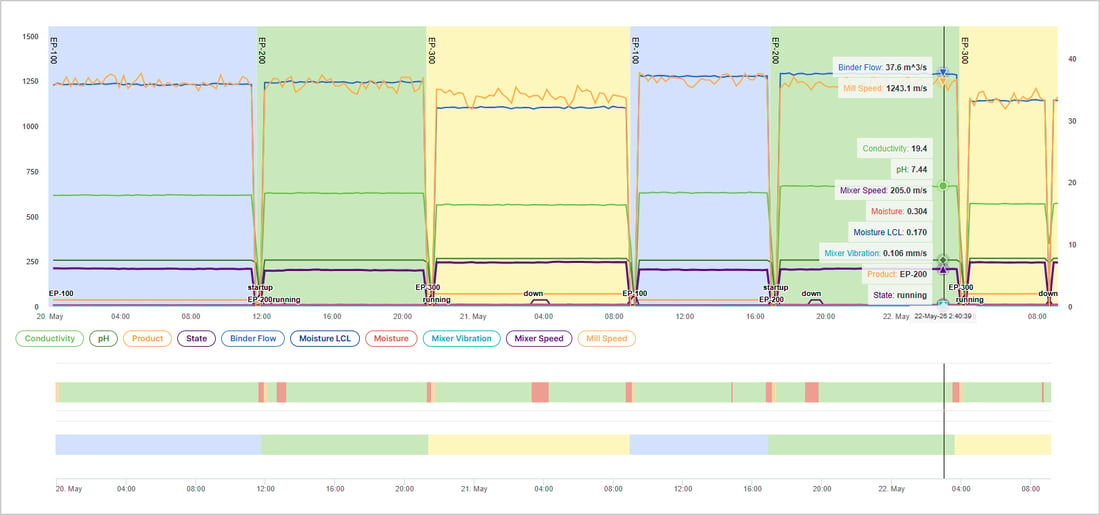
Data Contextualization Example: Time-series data with Operational Context of Product Changes and Operational States
CHAPTER 3
The Phased Industrial AI Strategy
Data readiness is only half the battle, readiness for action is the other. Many traditional analytics projects stall because they stop at static visualizations. They generate insights but leave them trapped on a screen, expecting a busy operator to manually interpret and adjust dozens of setpoints, introducing operational fatigue and delay.
True Industrial AI value is realized when you operationalize execution through a deliberate, trust-building approach that pairs advanced technology with proven plant floor change management:
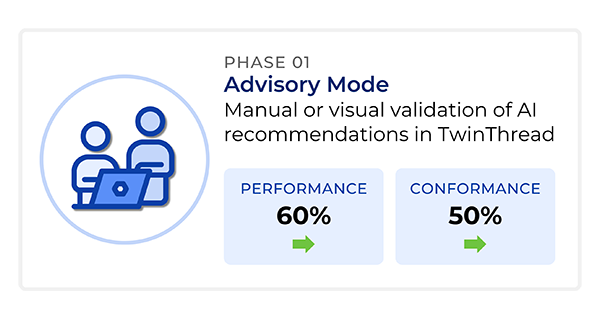
Phase 1: Advisory Mode
In the initial weeks, the AI runs in an advisory capacity to build trust. It surfaces the optimized setpoints on a screen, allowing operators to review the recommendations, compare them against current conditions, and build confidence in the AI’s suggestions.
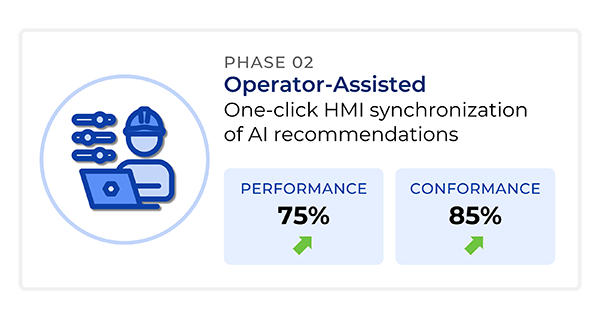
Phase 2: Operator-Assisted
Once trust is established, the system integrates with the HMI. When the AI identifies a new optimal condition, the operator is presented with clear recommendations. Operators can review and approve optimized setpoint recommendations through a single click that automatically sends validated adjustments to the control layer.
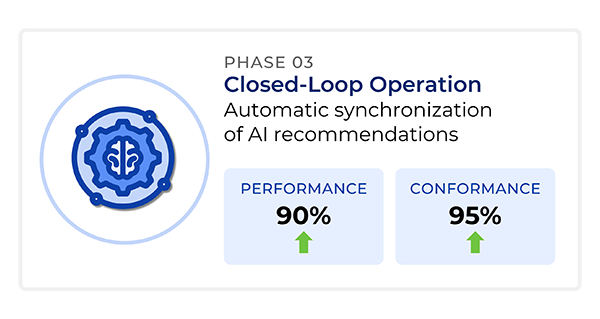
Phase 3: Closed-Loop Operation
The AI continuously and securely keeps the process optimized as products, materials, or ambient conditions change. Crucially, control remains in human hands, where operators can toggle the system back to manual mode at any given second if operational conditions dictate.
CHAPTER 4
The Data Readiness Checklist for Rapid Optimization
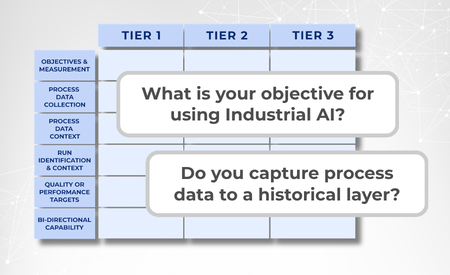
If your plant is currently running and tracking production, you likely already satisfy the criteria for immediate Industrial AI process optimization. You are ready to take the next steps by answering the following questions:
1. Objectives & Measurement
What is your objective for using Industrial AI?
Examples include improved quality, increased throughput, or reduced downtime.
What means do you have to measure the objective?
2. Process Data Collection
Do you capture process data to a historical layer?
Examples include a data Historian, SQL database, other Time-Series data source.
If not, is data accessible via an open protocol like OPC UA or MQTT?
3. Process Data Context
Do you follow a logical tag structure or asset hierarchy, with clear sensor naming conventions, that subject matter experts can easily map to real-world equipment?
4. Run Identification & Context
How do you distinguish in real-time when different products, grades, or recipes are running?
For example via Historian tags, MES, or production schedules.
5. Quality or Performance Targets
Do you have defined metrics for what good looks like, accessible via operational benchmarks or lab entries?
6. Bi-Directional Capability
Do you have a secure infrastructure framework that allows verified AI recommendations to be pushed or pulled to the automation layer?
Free Scorecard Tool
Industrial AI Readiness Assessment
This assessment will assign points to each of the six categories based on your current tier classification, then calculate your total score.
CHAPTER 5
Real-World Blueprint: Food & Beverage Extrusion
To understand how this works in practice, let’s look at a typical operationalization blueprint based
on a Food & Beverage Extrusion Line use case:
The Objective
Improved Quality & Process Capability (CpK)
The Data Readiness Profile
Industry
Food & Beverage
Process
Extrusion Line
Data Sources
Plant Historian & Quality Database
Data Footprint
Only 20 Data Items (Tags)
How Industrial AI Operationalizes This Dataset
Ingest & Contextualize
The AI connects to those 20 historical tags and overlays recipe context and operational status to identify the historical best runs.
Define the Objectives
The engine calculates the dynamic operating envelopes required to recreate those ideal conditions.
Deploy via Phased Automation
Phase 1: Advisory Mode: For the first couple weeks, operators run in an advisory mode, validating the AI’s recommendations.
Phase 2: Operator-Assisted: After a few weeks, operators automatically apply the AI’s recommendations with a single click, instantly aligning extrusion zone temperatures and screw speeds to the perfect target.
Phase 3: Closed-Loop Operation: In the final, closed-loop state, the AI maintains peak operational conditions automatically, allowing operators to focus on higher-value tasks all while having the freedom to revert to manual control.
Measuring Success
A successful Industrial AI program begins with establishing a valid baseline for key process parameters and objectives. The program gains can then be measured in a number of ways, including operator conformance to the AI’s recommendations and overall performance related to the defined objectives. Operator conformance regularly correlates to the defined objectives, such as a reduction in quality losses or unplanned downtime.
CHAPTER 6
How Industrial AI Supports Your Goals
Deploying a focused, use-case-driven Industrial AI solution that automates recommendations delivers massive benefits to both IT and OT teams. The work done to contextualize and automate data flows creates a proven digital template. Operators no longer suffer from alarm fatigue or constant manual process adjustments. The AI acts as a copilot, keeping the process perfectly optimized so the floor can focus on additional continuous improvement initiatives.
Getting Started with Industrial AI
Complement Your Data Strategy with Perfect Centerline
You don't need a robust, enterprise or cloud data architecture to start extracting tangible value from Industrial AI. Once you’ve completed the Data Readiness Checklist for Rapid Optimization, you are ready to take the next steps on a project with Industrial AI to start seeing real value in your organization.
TwinThread’s Perfect Centerline is built specifically to turn your existing industrial data into immediate operational wins. While your organization builds its data infrastructure for tomorrow, let us help you stabilize your lines, improve your processes, and automate your run-to-target conditions today.
Meet with an Expert
Schedule a 15-Minute Data Diagnostic Alignment Session with a Solution Architect

Industrial AI Readiness Assessment
This assessment will assign points to each of the six categories based on your current tier classification, then calculate your total score.
Got Questions? We Have Answers
TwinThread connects to virtually any Historian, MES, CMM, DCS, PLC, Sensor Gateway, or IoT platform in minutes. Our Edge Agent technology performs local processing and maintains a secure connection to the TwinThread Industrial Cloud Platform. TwinThread's pre-built solutions can be configured in less than an hour to proactively drive improvements across key operations and maintenance metrics.
Learn more about TwinThread's Platform.
TwinThread’s Industrial Cloud Platform was designed to solve the common productivity challenges industrial companies face today due to aging infrastructure, accelerating skills gaps, volatile supply chains, and regulatory compliance burdens. Our out-of-the-box pre-built solutions combine your sensor and process data with Industrial AI to improve a variety of metrics crucial to the success of your operations, such as quality, efficiency, and reliability.
By providing solutions with flexible deployment architectures, we help our customer’s digital transformation regardless of their current level of maturity, accelerating the process from pilot to broader enterprise-wide rollout.
The key to driving improvements is found in how recommendations from Industrial AI are “operationalized.” Operationalization is a combination of visualizations, analytics, and workflows that form an automated work process to translate your raw industrial data into recommendations and automated actions.
TwinThread’s Industrial Cloud Platform was built with operationalization in mind. Automated data capture, contextualization, visualization, and the ability to create customizable workflows based on AI allow you to realize incremental value at each step in your digital transformation journey.
Pre-built solutions, built around a standardized Digital Twin structure, embed AI into your production and identify opportunities for optimization. Through monitoring rules, AI surfaces critical anomalies that impact performance. These issues are automatically triaged, with actions passed to the right resources for resolution.
Coordination of those actions and the broader implementation of operationalization require a digital command hub, TwinThread’s Virtual Operations Center. This extends the reach of subject matter experts, allowing them to manage and monitor operations across various locations and systems. The VOC, as part of the Industrial Cloud Platform, can be rapidly and easily scaled. It enables teams to digitize their knowledge and collaborate on recommendations and innovation opportunities across their entire operations.
Typically, there are three types of systems that TwinThread connects to and works with:
1. On-Premise Automation and Information Systems: PLCs, DCSs, Historians, and MES systems. TwinThread has developed deep integrations with the most popular vendor solutions.
2. IoT Gateways and Smart Sensors: Our "IoT Hub" enables direct streaming data connections from various vendors' sensors using multiple protocols and various communication networks.
3. Cloud-to-Cloud Applications: This includes leading cloud vendors and industrial cloud applications. Similar to On-Premise, we have developed deep integrations with the most popular vendor solutions.