How Smucker’s Used TwinThread to Build a Standardized Data Foundation, Identify Operational Gaps, and Improve Visibility
Success Story

- Industry: Food and Beverage / Consumer Packaged Goods (CPG)
- Region: North America
- Data Foundation: Edge Agents, Digital Twins, Digital Threads
- Current Solutions: Perfect Centerline and Multi-Objective Model
- Deployment: 3 sites (Scottsville, KY; Longmont, CO; McCalla, AL)
Implementation Overview
Data Challenges
- Production data was isolated and housed in different data sources.
- Smucker’s had data integrity and latency issues. Time discrepancies between machine data and lab quality data caused misaligned timestamps within Smucker’s Plant Apps database.
- Smucker’s had blind spots. As initial models struggled to account for process drift, TwinThread revealed where additional sensors were needed to capture critical data.
Establishing the Right Foundation
To confront these challenges, Smucker’s unified its data using TwinThread’s platform. That process progressed through three phases:
Data Connection. TwinThread’s Edge Agents extracted data from Smucker’s data sources. Machine data was pulled from on-premise historians like AVEVA PI, while event and quality data came from Smucker’s databases. Vision system data, which evaluates product defects and hole counts, was also connected.
Digital Twins. Engineering teams mapped equipment and the asset structures of frozen handheld production lines into a structured digital twin hierarchy.
Digital Threads. TwinThread and Smucker’s teams initially set up thread logic and custom SQL queries to reduce noise and correct timestamp errors. However, as performance visibility improved, the team realized some context-reliant processes required more substantial workflow changes to capture data.
Initial Learnings With Industrial AI
With a stronger data foundation in place, Smucker’s began configuring and testing TwinThread’s models and solutions. Teams at all three sites had important realizations:
- Deployment discipline matters. Success with Industrial AI requires clear best practices in areas like data readiness and use case development.
- Complex assets and processes require modular models. Equipment needs its own variables and controllables, and process segments should be stabilized individually.
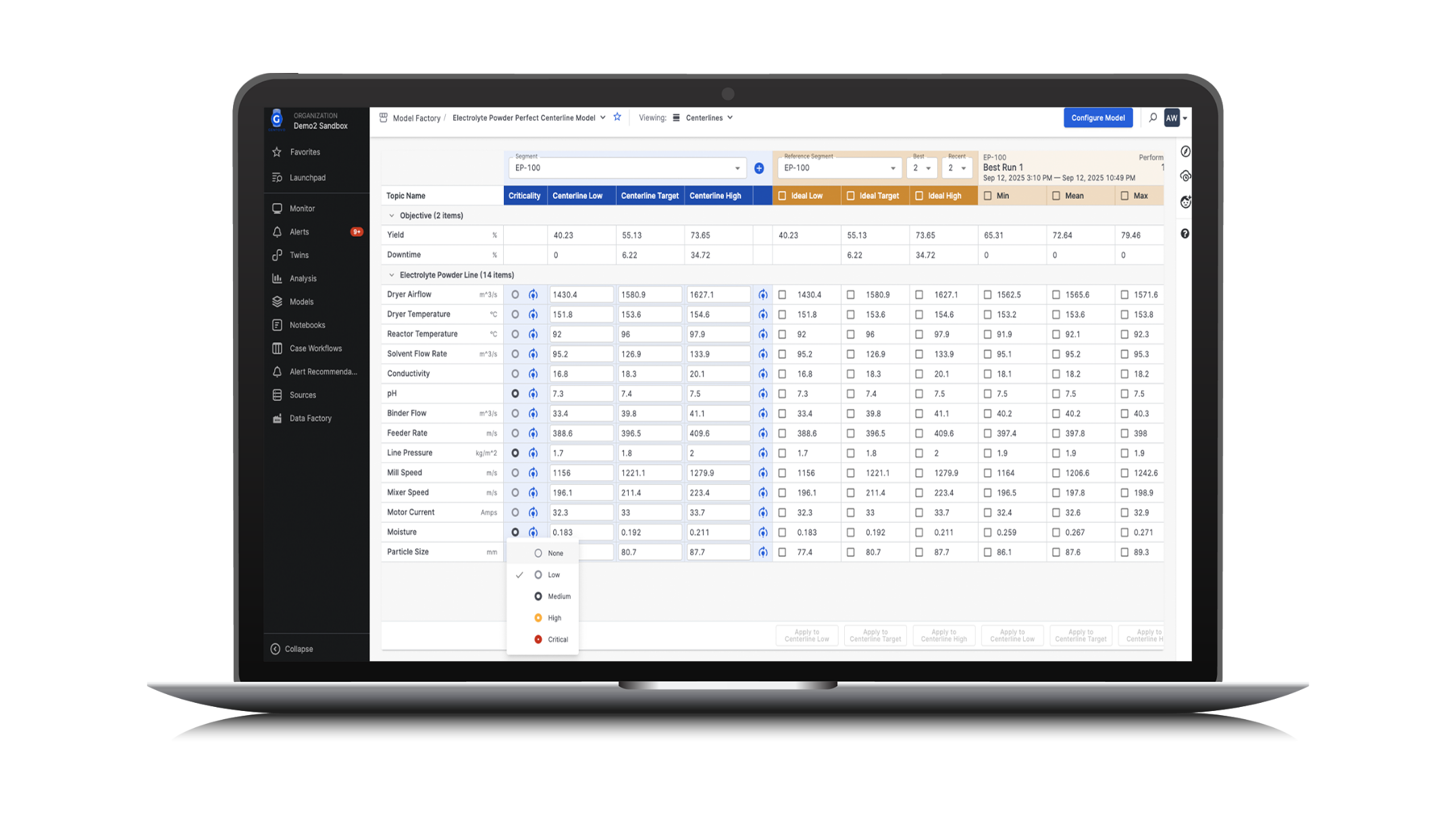
- Perfect Centerline is a necessary starting point for asset and process control.
- Plan for scale from the beginning of the project. If models are built as one-offs, it becomes hard to repeat success. Standardizing the basics, like naming conventions, helps ensure models stay tied to the assets and processes they’re meant to improve.
TwinThread’s no-code and low-code tools enabled Smucker’s to test, evaluate, and iterate rapidly. They gave team members with little to no data science experience the ability to build on their own.
Value and Next Steps
This implementation improved Smucker’s data connectivity, enhanced visibility, and now provides a legitimate path toward process stabilization.
Smucker’s is now in solution control trials. At Scottsville, teams are transitioning to Centerline-based control for its ingredient deposit systems, with plans to expand into the bakery process and reduce downstream variability. They also plan to test how vision system data can add to model context and inform centerlines. At Longmont, teams are currently validating the Multi-Objective Model’s configuration and recommendations. These efforts are helping Smucker’s determine what works and what’s repeatable across additional lines and facilities.
Across the organization, Engineering leadership is also focused on operator adoption. Through simplifying HMIs with TwinThread-driven insight, Smucker’s aims to make Industrial AI actionable on the plant floor.
Explore More TwinThread Success Stories
Solution Demo
Perfect Centerline
See how Perfect Centerline identifies your top runs and optimal operating conditions.

White Paper
Perfect Centerline
Baseline your optimal run-to-run range, eliminate variability, and make your best run the new standard